This article is a summary of Chapter 1, “Understanding Low Mood," from Dr. Julie Smith’s bestselling book Why Has Nobody Told Me This Before?.
The Mask We Wear: Relatability in the Struggle
In Chapter 1, Dr. Julie addresses a universal struggle: the tendency to mask low mood. Many of us reflexively push these feelings away or hide them behind a brave face, viewing a dip in mood as a personal failure or a “fault” in our brains rather than a signal to be understood. This isolation is often amplified by social comparison. When we look around at others who appear to “have it all together,” we internalize our struggles as an individual defect, pulling the mask on even tighter.
Redefining Mood: A Sensation, Not an Identity
The core shift in Dr. Julie’s approach is realizing that your mood does not define who you are—it is simply a sensation you are experiencing. When a dip occurs, your brain immediately goes on a “hunt for reasons” to explain why. It acts like a master detective, but it doesn’t just look at your immediate thoughts. It gathers clues from your entire life experience.
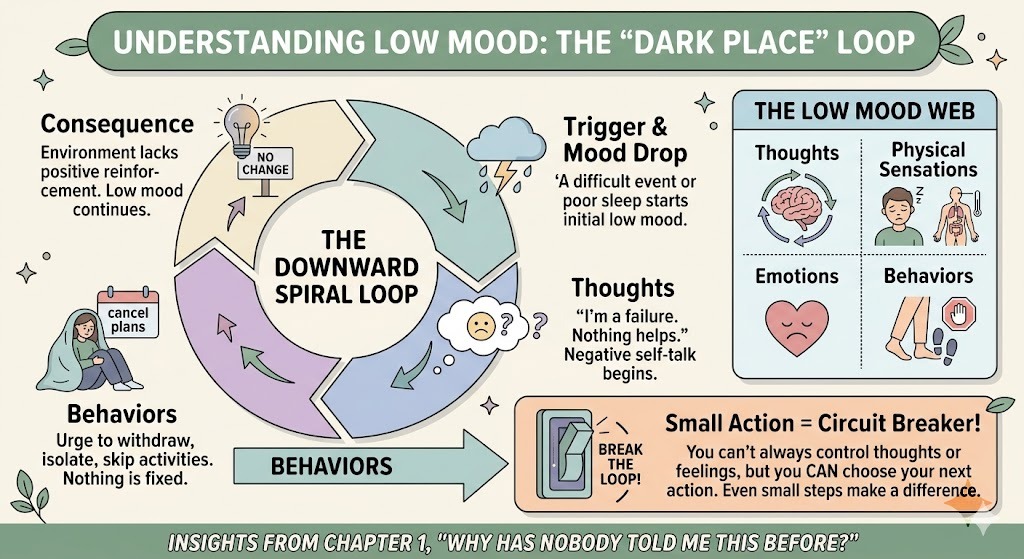
Crucially, low mood is not just “in your head." It is deeply entwined with a web of moving parts:
- Your physical body state: Sleep, nutrition, movement, and physical health.
- Your relationships: The presence of support or conflict in your social sphere.
- Your history: Both past experiences and your current living conditions.
- Your overall lifestyle: Habits, stressors, and daily routines.
The “Two-Way Road” and the Vicious Cycle
Because mood is connected to so many factors, there is a constant feedback loop running between your internal world and your environment. This “two-way road” means that how you feel influences your thoughts, and your thoughts, in turn, reinforce your physical mood.
When things go south, we often get trapped in a vicious cycle where thoughts, bodily sensations, emotions, and actions all collide at once. Because these elements hit simultaneously, a low mood can quickly feel like an overwhelming, tangled mess. Dr. Julie’s approach encourages us to untangle the knot by breaking it down into bite-sized pieces. By isolating these individual components, we can begin to recognize exactly what is keeping us stuck.
Empowerment: Taking the Reins of Emotional Health
Once we demystify this feedback loop, the narrative shifts from helplessness to empowerment. Understanding that the brain, body, and environment are constantly talking to one another reveals a comforting truth: you have more power to influence your emotions than you think. You don’t have to wait for your mood to magically lift; you can take your emotional health into your own hands by using practical, everyday tools to disrupt the cycle.
Where to Start: Building Awareness
To begin actively influencing your mood, Dr. Julie suggests a structured, three-step approach to building self-awareness:
- Hindsight to Insight: Start by reflecting on difficult moments after they happen. Look back and piece together what triggered the dip. With practice, this retrospective awareness shifts into real-time insight, giving you the chance to change course mid-moment.
- Expanding Awareness: Once you become adept at noticing your internal state (your mind and physical body), turn your lens outward. Observe how your external environment, physical spaces, and relationships directly impact your behavior.
- The Power of Writing: Journaling or tracking your state on paper is a vital tool. Writing things down externalizes the clutter in your head, making it much easier to objectively recognize patterns of what makes things better or worse.
By using these secrets from a therapist’s toolkit, we can transform our understanding of low mood from a source of shame into a completely manageable part of the human experience.